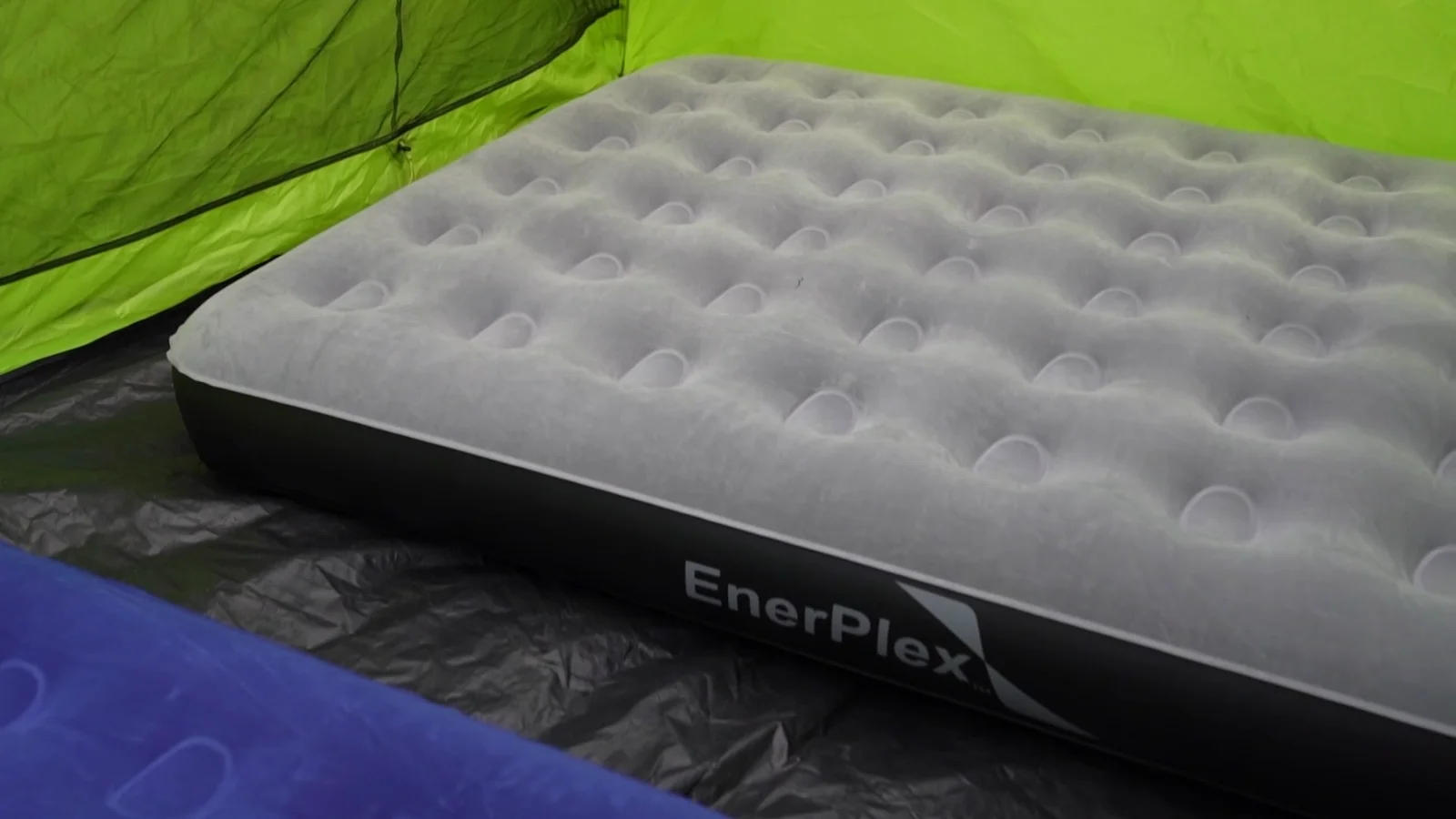
Every camping trip contains two trips. There is the daylight one, with the trail and the fire and the photographs, and there is the night one, conducted horizontally on whatever you brought to put between yourself and the planet. The daylight trip gets all the planning. The night trip decides whether anyone wants to come back. Winning the night trip comes down to four decisions: what the ground actually does to a sleeping body, why the rangers' packing advice starts underneath you, how our nine-inch camping line is built for the job, and what to do about the smallest traveler in the tent.
As always at EnerPlex airbeds, the guidance we lean on is public and linked at the end with the dates we read it, the product facts are our own build decisions, and the quotes are real customers saying what they actually said.
What the ground does to sleep
The ground is not neutral. It is an infinite heat sink at whatever temperature the season left it, and a sleeping human is a warm object placed directly against it. Two things then happen, both bad.
The first is conduction. Compressed insulation does not insulate: the loft of a sleeping bag is what traps warm air, and under your body weight that loft is crushed flat, so the bag that is rated for the night air above you is doing almost nothing below you. Heat flows from the warm side of the sandwich to the cold side all night long.
The second is moisture. The National Park Service's packing guidance is blunt about the order of operations: lay something down before the sleeping bag, because moisture accumulating beneath your body robs it of heat. A cold, slightly damp 3 a.m. is not a rite of passage. It is a physics problem with a checklist solution, and the checklist starts under your spine.
That is the whole case for a real camp bed in one paragraph. Everything else, comfort, joints, dignity at sunrise, is a bonus on top of thermodynamics.
Air versus foam, without the tribalism
Campers argue pads versus airbeds the way households argue thermostats. The rangers list both as legitimate, so here is the honest comparison from a company that builds one of them:
| Closed-cell foam pad | Camping airbed | |
|---|---|---|
| Warmth mechanism | Trapped-cell insulation, thin but constant | Air gap plus distance from ground moisture |
| Comfort depth | An inch or so | Nine inches on our line |
| Side sleepers | Hip meets planet | Hip floats |
| Bulk in the car | Strapped to the roof of the pack | A shoulder bag |
| Setup | Unroll | About two minutes of pump |
| Failure mode | Nearly none | Puncture, patched in five minutes |
| Backpacking miles from the car | The right answer | The wrong tool, honestly |
The summary we give our own friends: if you carry your camp on your back, take foam and enjoy it. If your camp arrives by car, truck or canoe, the airbed wins the night by a distance that has to be slept on to be believed, and a thin foam pad underneath it in cold seasons is the belt-and-suspenders move that costs nothing to pack.
One of our reviewers, a self-described veteran of a fifteen-year pad-and-bed rotation, compressed the switch into a sentence:
We got this to replace a fifteen-year-old Aero mattress that finally sprang a leak.
Beds in this category are not disposable gear. Bought well and patched honestly, they are decade equipment.
Why the camping line is nine inches, not sixteen
Readers of our guest-bed guide, The Guest Room That Lives in a Closet, will remember us spending three paragraphs praising double height. So why does the camping series stand nine inches tall? Because a tent is not a living room, and the constraints flip:
- Headroom is the ceiling of the whole experience. A sixteen-inch bed under a two-person tent's sloped wall leaves you dressing on your knees with your face in the fly. Nine inches leaves air above you.
- Weight and bulk ride in your trunk. The camping twin packs into a shoulder bag with its pump, plugs and patch kit riding along. Double-height chambers cannot do that.
- Wind exists. A lower profile with a sleeping bag on it stays put. Camp furniture that stands tall catches gusts through an open fly.
- Nine inches is still nine inches. That is the entire thickness of many home mattresses, and it is a different universe from the inch of foam it replaces. The hip of a side sleeper never reaches the planet.
The construction is the same argument as the home line, shrunk: welded coil beams keep the surface flat, three layers of puncture-resistant PVC face the tent floor, the top is flocked so the sleeping bag does not toboggan, and the twin is rated to three hundred pounds. The footprint runs about three and a quarter feet by six and a quarter on the twin, with the queen wide enough for two sleeping bags to negotiate peace.
Do people sleep on them long-term? We did not design for it, but our review pages say yes, and the most quoted voice on our camping twin has been filing updates for years:
We've been sleeping on this mattress nightly for two years now.
We would still rather sell you the sixteen-inch queen for home duty. But it is good to know what the welds can do.
Power where there are no outlets
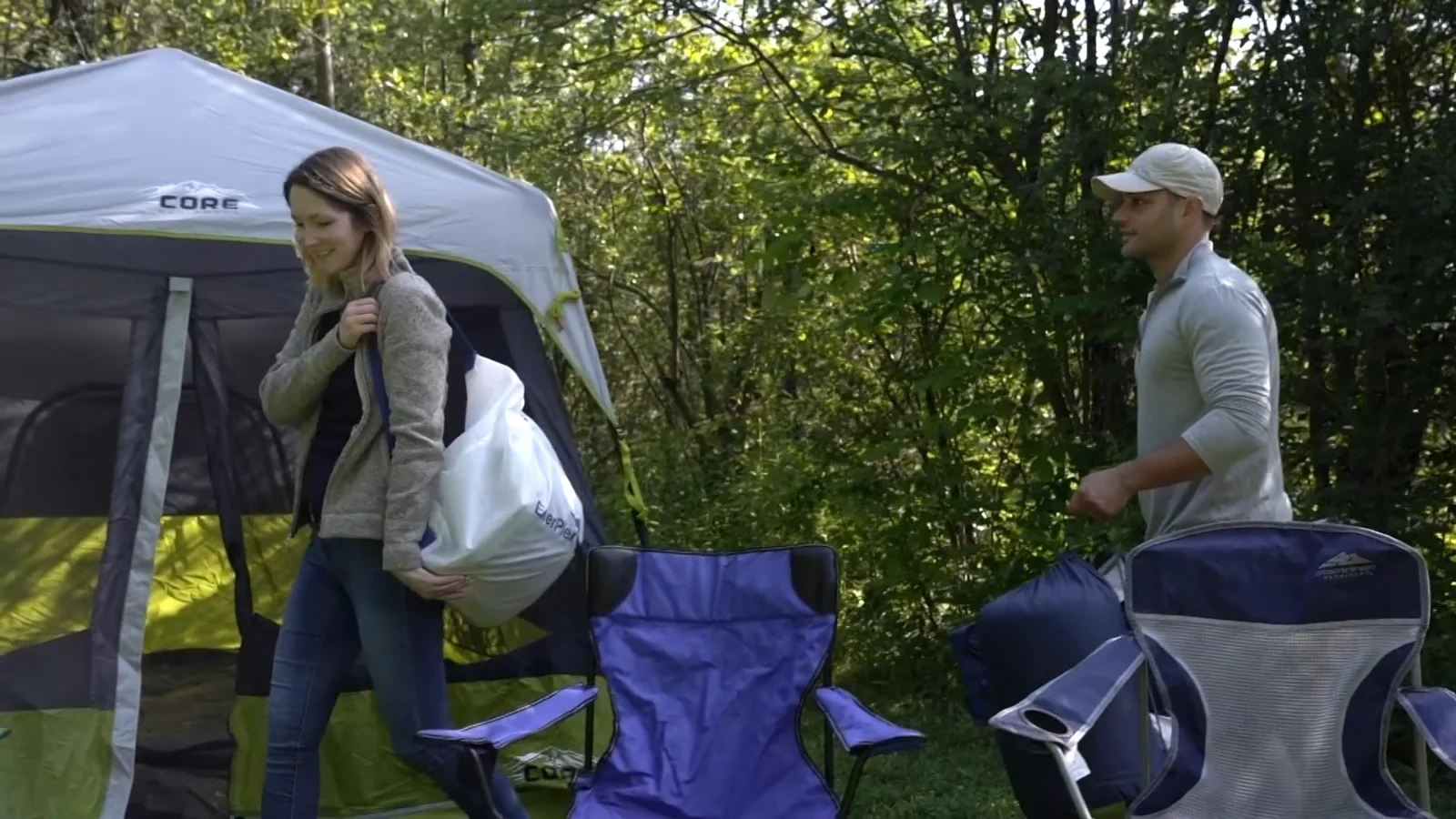
A camp bed with a wall-only pump is a bed that works everywhere except camping. Our camping kit ships with the answer in the bag: a detachable high-speed pump with a wall plug for the night before and a 12-volt car adapter for the site itself. The routine that follows is almost embarrassingly practical.
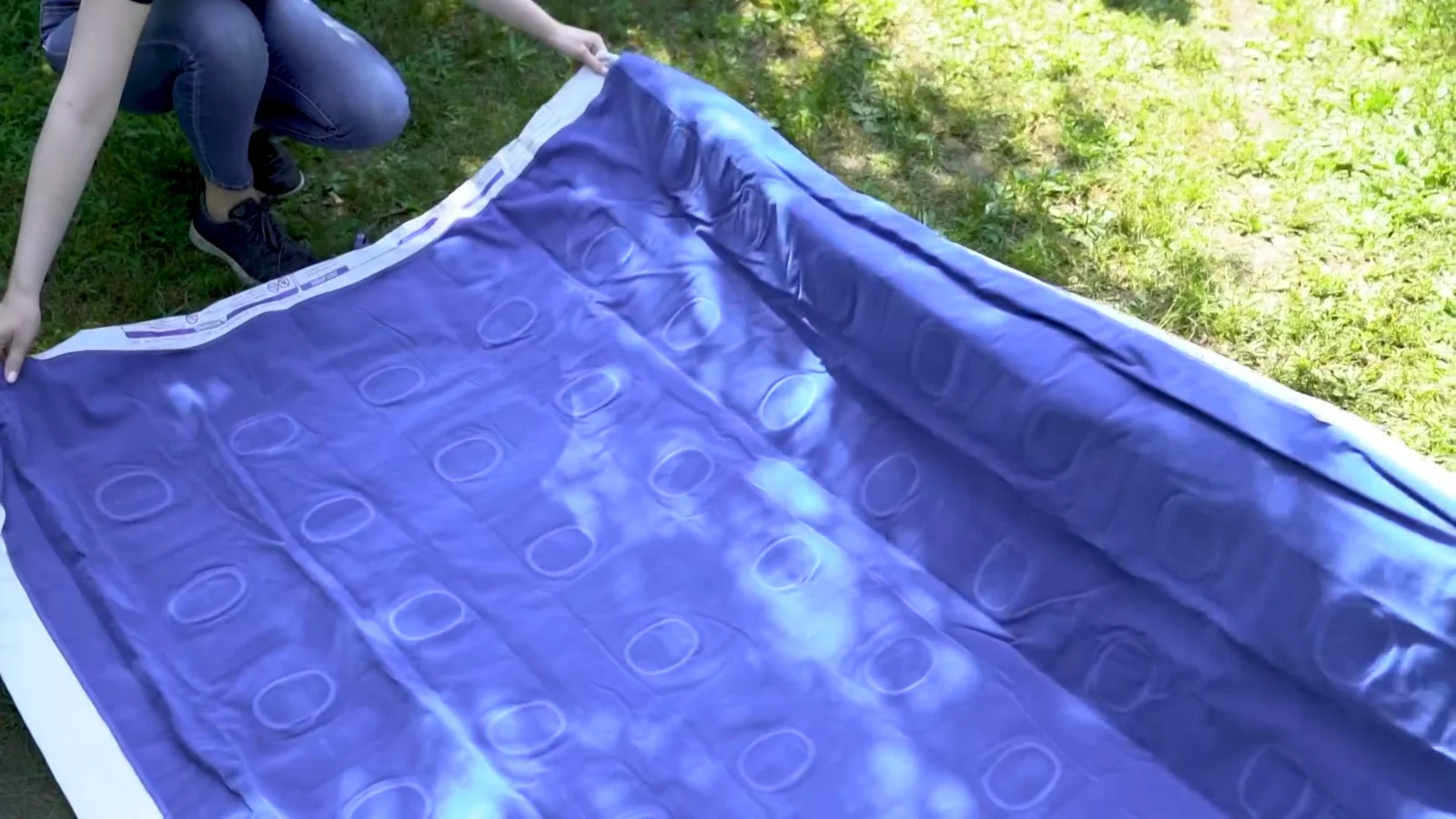
Inflate at home first. Run the bed up the night before departure, let it stand an hour, and listen to it. A new bed's first-night stretch and any surprise from storage shows up in your living room, where the patch kit, the warranty inbox and a spare bed all live, instead of at a trailhead at dusk.
At the site, the car is the outlet. Park within cord's reach of the tent pad before unpacking anything else. Two minutes of adapter pump per bed and the bedroom is done before the fire is lit. One of our queen reviewers chose the bed for exactly this arithmetic:
My major deciding factor was the claim of the fastest pump on the market.
If the trip involves a bed and a car parting company for days, the detachable pump earns its keep twice: it inflates the bed and then leaves with you, weighing ounces, instead of sulking uselessly inside a chamber wall. And a manual fallback costs nothing to know: with the valve open, the bag the bed came in can be pressed into service as a crude bellows in a genuine emergency. Slow, ridiculous, effective.
The tent-fit arithmetic
Tents are sold by sleeper count and beds by mattress size, and the two vocabularies barely speak. The translation table, learned the hard way so you do not have to:
| Tent on the label | Floor reality | What actually fits |
|---|---|---|
| 2-person | about 7 ft x 5 ft | One camping twin plus gear aisle, or two very friendly foam pads |
| 4-person | about 8 ft x 7 ft | One camping queen plus a gear corner, or two twins |
| 6-person | about 10 ft x 9 ft | A queen and a twin, or a queen plus the kids travel bed |
Two rules of thumb ride along. First, subtract one from every tent label before trusting it with beds: a four-person tent sleeps two adults on a queen in comfort, four adults only in the brochure. Second, inflate the beds inside the tent, not outside it. A fully inflated queen does not fold through a tent door, a fact that is obvious exactly one second too late.
The toddler question
Sooner or later every camping family, and every family that travels at all, meets the same problem: the one bed a small child trusts is the one bed that cannot come along. Hotel beds are cliffs. Shared airbeds put a toddler between two rolling adults. The floor is the floor.
We built the kids travel bed as the purpose-made answer, and its design brief was written by parents rather than by us: a toddler-scale inflatable with a raised bumper rail around every edge, a footprint that standard crib and toddler sheets fit over, so bedtime smells like home, and a high-speed pump that finishes before the bedtime story does. It weighs bag-plus-child-sized-bed, which is to say almost nothing, and it works exactly the same at a campsite, a grandparent's spare room and an apartment two time zones away.
The voices that convinced us we had built the right thing were specific. One family took it across an ocean:
We got this to take on our trip to Albania for our 2 yr old to meet her grandparents.
Another, traveling with a child for whom unfamiliar rooms are genuinely hard, measured the value in a settled night:
I kept going back and forth bc of the price tag but it was 100% worth it, our sensory sensitive toddler son loved this on vacation.
And the retirement notice we consider a five-star review of the whole concept:
My little guy loved it for years, until he just could not stretch out in it anymore.
Now the boundary, stated as plainly as we can state it, because it matters more than any sale. The travel bed is for toddlers who have already outgrown the crib stage. It is not for infants. The American Academy of Pediatrics' safe-sleep guidance is unambiguous: babies up to one year sleep on a firm, flat surface that meets federal crib standards, a surface that should not indent when the baby is lying on it, with no soft objects or loose bedding in the sleep area. No inflatable surface meets that description, ours included, and no camping schedule changes it. For an infant, the answer is a portable crib or play yard that meets the standard, pitched inside the tent like everything else.
Care in the field
Camp treats equipment worse than closets do, so the camping line earns a slightly longer care list than its indoor cousins.
- Sweep the pad before the bed goes down. The triple-layer skin shrugs off tent floors, but a pinecone under three hundred pounds of sleeping family is a press die. Thirty seconds of hand-sweep is the cheapest insurance in camping.
- Expect the cool-evening soft-off. Air contracts as the temperature drops, and a bed inflated at a warm 6 p.m. reads softer at a cold midnight. That is physics, not a leak. Thirty seconds of pump before bed in shoulder seasons, and the tell for an actual leak is a bed that keeps softening in stable temperatures.
- Cold ground still wants a layer. Nine inches of air beats the planet's chill, but in spring and autumn a thin foam pad or wool blanket under the bed adds the insulating layer air alone cannot, exactly the layered logic the rangers pack by.
- Never pack it wet. Dew happens. A towel-wipe and ten minutes over a camp chair before rolling costs nothing. A bed rolled up damp and stored for a month comes back with problems no patch kit addresses.
- The patch kit lives in the bed bag. Not in the junk drawer at home. A thorn is a five-minute fix at the site with the kit at hand, and a ruined trip without it.
Breaking camp: the five-minute teardown
Packing out is where good sleep systems go to die, because it happens in the morning, in a hurry, sometimes in drizzle, and always after coffee has been promised but not yet delivered. A teardown order that protects the bed takes no longer than a careless one. It just runs in the right sequence.
Strip the bed first and bag the bedding separately. Sleeping bags and sheets rolled up inside a mattress trap the night's moisture against the vinyl, which is exactly the packing-wet mistake in disguise. Bedding travels in its own sack and meets the washing machine at home.
Deflate with the pump, not with body weight. The car adapter works in reverse just as it does forward: the pump pulls the chamber genuinely empty in about the time the tent poles take, and a truly empty bed folds along its shipped creases without fighting back. The traditional method, kneeling on the bed and rolling toward the valve, works poorly and looks worse, and it leaves enough residual air to double the folded size.
Wipe, dry, roll loose. Dew on the underside is normal. A towel pass and ten minutes over the tailgate while the rest of camp packs is enough. Then the loose roll, the bag, and the shoulder strap. At home, the bed goes back on its shelf dry, with the pump and patch kit inside, already ready for the next trip, which is the entire discipline in one sentence: the teardown you do in five minutes at the site is the setup you thank yourself for at the next one.
One more small habit separates decade-old camp beds from short-lived ones: give the bed a shelf indoors, not a corner of the garage. Vinyl dislikes freezing winters and baking summers roughly as much as sleepers do, and the closet that holds the guest bedding has room for a shoulder bag beside it.
The one-bag night kit
The whole guide, packed:
- The camping bed in its shoulder bag, twin per adult or queen per couple, test-inflated at home the night before
- Pump, wall plug and car adapter, plus the patch kit riding in the same bag
- A thin foam pad or wool blanket for under the bed in cold seasons
- Sleeping bags rated for the location and season, per the rangers' own rule
- The kids travel bed and a set of crib sheets from home, for the smallest traveler past the crib stage
- Dry sleep clothes, changed into at the last minute, which the rangers also swear by
Adults sleeping their recommended seven to nine hours in a tent is not a myth. It is a stack of small physical decisions, and every one of them is packable. Prices and stock for the whole camping line live on the front page, updated on the schedule described in How we update this catalog, and if the same trip ends with a pillow conversation, the loft guide at Loft, Alignment, and the Number by the Bathroom Door picks up where this one stops. The ground will be there either way. The difference is nine welded inches, and which side of them you wake up on.
