- Why height is the whole trick
- The pump, and why built-in beats better
- Sizing the room, not the guest
- The two-minute routine, minute by minute
- Firmness and the first three nights
- Making it look intentional
- How an airbed lives for ten years
- Who a guest airbed is for, and who should skip it
- Questions guests actually ask
- The closet-shelf checklist
There is a specific silence that falls over a household at about nine in the evening when a guest turns out to be staying the night. Everyone is smiling, and everyone is doing arithmetic. The couch is five foot ten of lumpy diplomacy. The floor is a yoga mat and an apology. The spare room, if it ever existed, has been an office since the second lockdown. That arithmetic can end permanently, for the cost of one closet shelf, with the double-height airbeds we build and the routine that keeps one guest-ready for a decade.
Everything below comes from the same three places as the rest of EnerPlex airbeds: our own build decisions, the public sleep guidance we actually read, and the customer reviews that tell us the truth whether we like it or not.
Why height is the whole trick
Ask anyone who dislikes airbeds why, and after the leak stories you will hear one word: floor. A classic nine-inch inflatable puts the sleeper's face a hand-span above the coldest, dustiest layer of air in the room, and getting out of it is a controlled fall in reverse. It works in a tent, where everything is low. In a hallway-adjacent home office, it feels like a demotion.
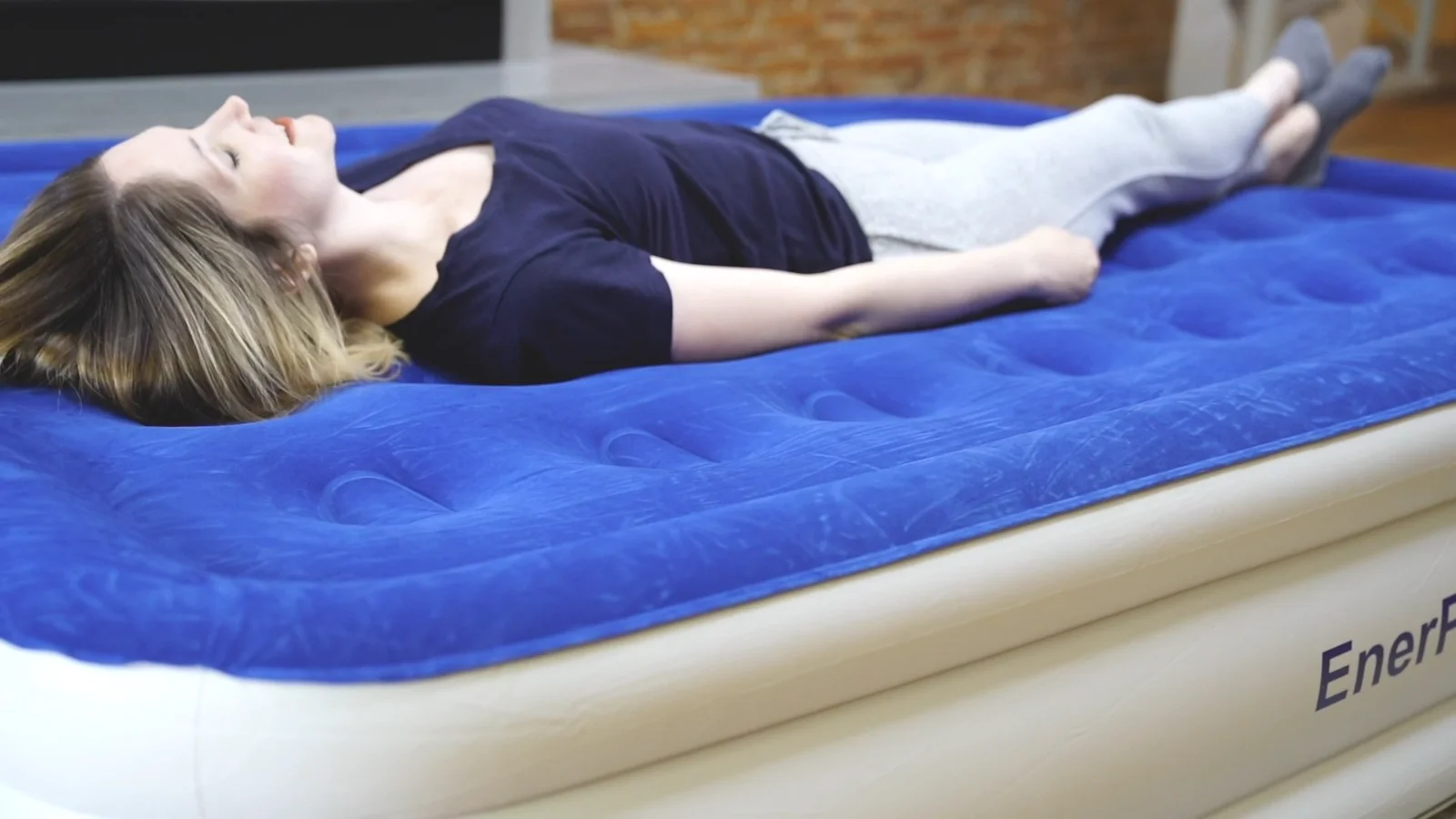
Double height fixes almost all of that at once. Our home line stands thirteen to eighteen inches tall, which is the height range of ordinary mattresses on ordinary frames. The consequences run further than dignity:
- Guests sit down onto the bed and stand up out of it. For anyone with a bad knee, a bad back or six decades of either, this is the difference between using the bed and quietly choosing the couch.
- The sleeping surface rises above the floor's cold-air layer. Warm air stratifies upward in a room, and a bed at sixteen inches sleeps noticeably warmer than the same chamber at nine, on the same thermostat.
- Bedding behaves. A double-height chamber has a vertical side wall for fitted sheets to grip, so the bed can be made, properly, with corners, and look like furniture instead of a raft.
- The bed reads as intentional. A made-up sixteen-inch bed beside a lamp says we planned for you. A mat on the floor says we lost.
The height comes from a second stacked chamber ring, not from ballooning a single bag taller, which matters because pressure in a tall single bag turns the bed into a drum. Inside both rings, welded coil beams pull the top flat, and that flatness is what lets two adults share the queen without a midnight summit in the middle.
The pump, and why built-in beats better
Every guest-bed disaster story has the same second act: the bed is found, and the pump is not. It is in the garage, or it went camping, or its nozzle fits the old bed. By the time someone is inflating a mattress with a hair dryer and a rolled-up magazine, the evening is a story their guest will tell for years.
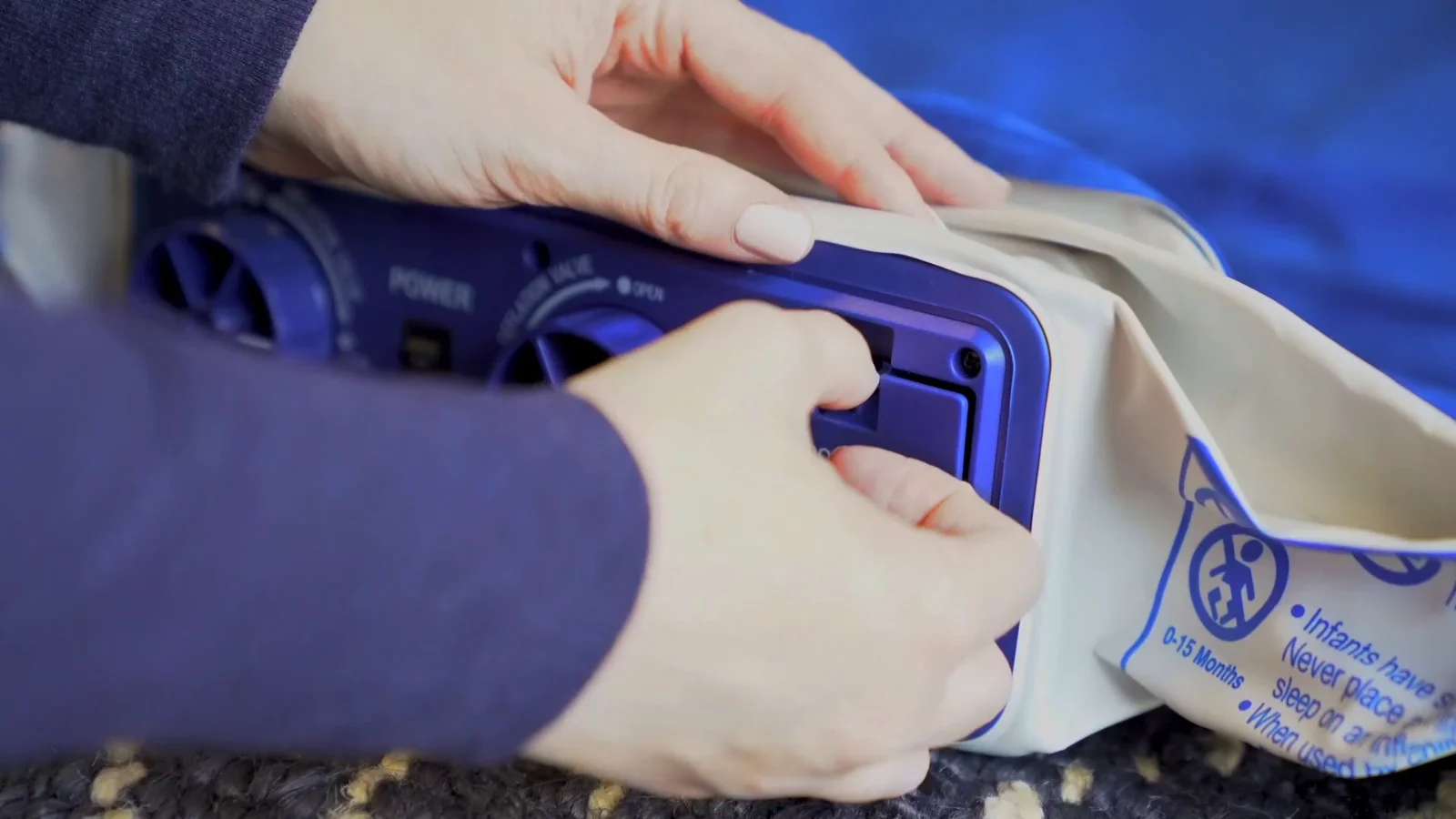
So we put the pump inside the bed. On the whole home line it lives in the chamber wall and runs from an ordinary wall socket: one dial, turned one way to inflate, the other way to deflate. There is nothing to find, nothing to attach, and nothing to lose, and that single decision does more for the odds of a good night than any comfort feature we could name. About two minutes of pump noise takes the queen from a folded bag to a firm, flat surface. The twin runs faster.
One honest limitation, straight from a four-star review we have no intention of hiding:
One of my first major gripes was the AC cord for the bed is very short, which is a pain for rooms that are not completely open/free.
That is fair, and worth planning for: the pump wants a socket within reach of where the bed will stand, and in socket-poor rooms an ordinary extension cord belongs in the same closet as the bed. Two minutes of setup assumes you are not moving furniture to find power.
Buyers who compare us to what they used before tend to make the same discovery. One review of our twin, left after trying another maker's bed, puts it plainly:
I recently purchased a different brand air mattress. This has made me realize that I really like this air mattress.
Sizing the room, not the guest
The natural instinct is to buy the biggest bed the budget allows. The correct instinct is to measure the floor. An inflated queen claims roughly five feet by six foot eight, and a room that holds it with no walking space left has not gained a guest room, it has lost an office. Here is the arithmetic in one table, using our double-height line:
| Size | Inflated footprint | Stands | Rated for | The room it suits |
|---|---|---|---|---|
| Twin, 16 in | about 3 ft 2 in x 6 ft 4 in | 16 in | up to 300 lbs | Offices, kids' rooms, any strip of floor a yoga mat fits twice |
| Queen, 13 to 18 in | about 5 ft x 6 ft 8 in | 13, 15, 16 or 18 in | up to 600 lbs | Living rooms, real spare rooms, couples |
| King, 16 in | wider than the queen by over a foot | 16 in | two adults, comfortably | Large living rooms only, and measure first |
Three notes from the checking bench:
- The twin is the sleeper hit of the range. It fits where queens cannot, one adult sleeps royally on it, and two twins in a living room beat one queen for any pair of guests who are not a couple.
- Between queen heights, the choice is about who visits. Thirteen inches stores smallest, sixteen is the all-rounder, and eighteen, the tallest we build, is the one to pick when your regular guests include grandparents.
- If the pillow always ends up on the floor, that is not the guest's fault, it is geometry: a smooth head end gives a pillow nowhere to stop. Our pillow-rest models raise the head end of the chamber itself, which solves pillow drift at the architectural level.
The two-minute routine, minute by minute
Two minutes sounds like marketing until you split it into its parts, so here is the whole procedure, timed the way it actually runs on our sixteen-inch queen:
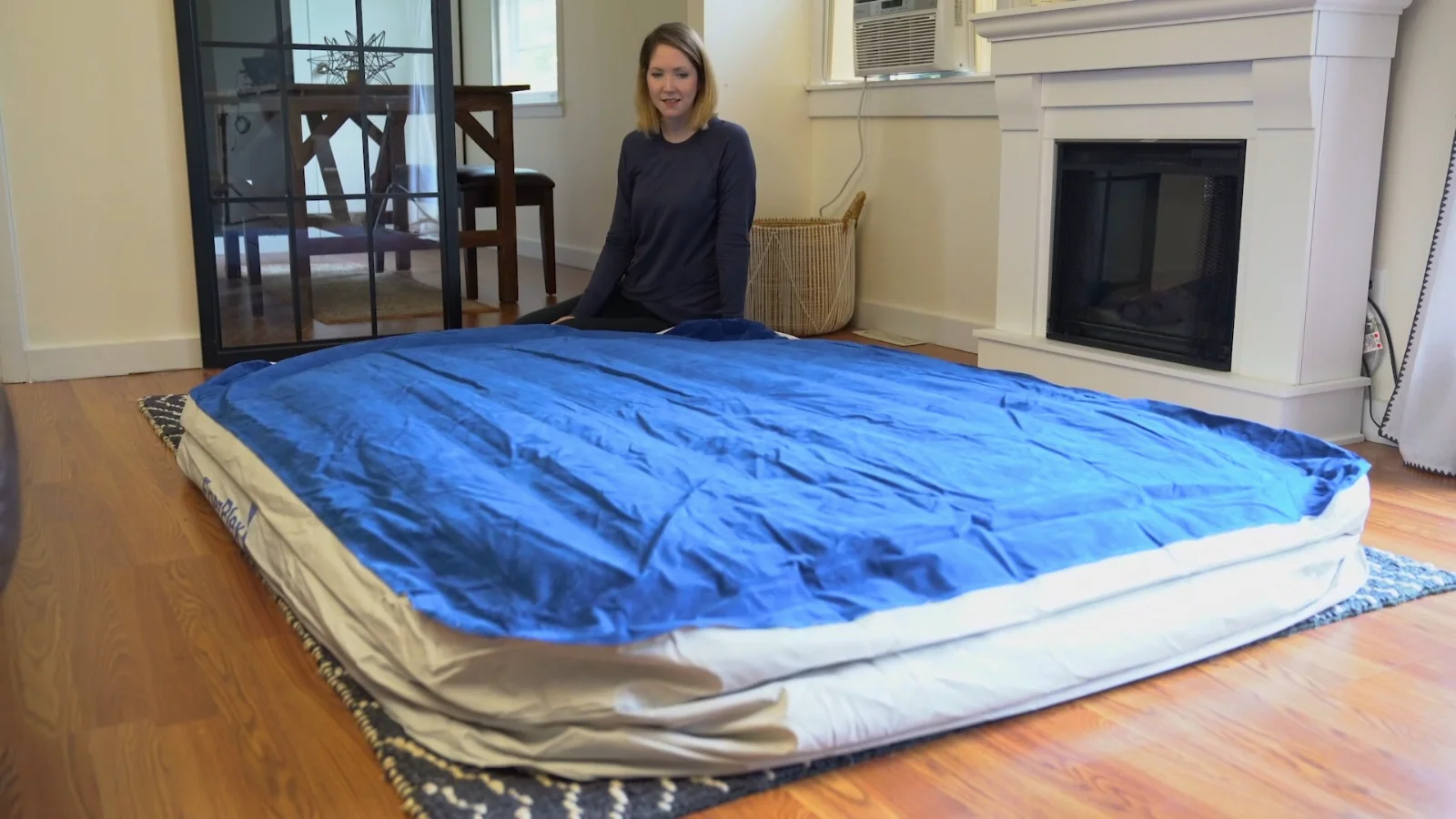
- Zero to twenty seconds. Bag off the shelf, bed unrolled on the floor, valve dial checked. The unroll is the step people rush. Give the vinyl one flat second so no fold inflates trapped.
- Twenty seconds to about two minutes. Dial to inflate, and walk away. This is kettle territory: the pump does not need supervision, and the firmness is right when the surface takes a knee-press without pooling around it.
- The last thirty seconds. Fitted sheet, flat sheet, blanket, pillow. A double-height bed makes like a real bed, and corners actually hold.
Deflation, the half nobody advertises, is the same dial turned the other way. The pump pulls the air out, the bed flattens itself while you fold breakfast into the conversation, and the roll goes back in its bag. Guests who have fought a self-styled self-deflating bed will know why we mention this at all.
Firmness and the first three nights
Now the paragraph most brands leave out. A brand-new airbed will feel softer on night two than it did on night one, and a cool room will read softer than a warm one. Neither is a leak. New PVC stretches slightly as it settles into shape across its first nights, and air contracts as it cools, which lowers pressure. The physics does not care whose logo is on the valve. The fix is thirty seconds on the dial before bed for the first few nights, after which the material settles and the top-offs become rare.
Our long-term reviewers describe exactly this settling curve, and it is why we designed the flagship the way we did. One five-star review of the queen, from a buyer using it as a permanent second bed, says it without decoration:
Use the air mattress as our second bed. Works well. Need to reinflate it after a few days use but very comfortable.
For hosts who never want to think about it, the dual-pump flagship carries a second, quiet pump that monitors pressure and tops the chamber off automatically through the night: firmness at lights-out is firmness at dawn, enforced by hardware rather than by memory. And across the line, buyers who tested our service found the promise underneath it real. As one long review of the twin opens:
I purchased this air mattress/bed after reading all of the positive reviews and I'm glad that I did.
The review's title is its summary: the two-year warranty is genuine.
Making it look intentional
A guest bed earns repeat use when it stops reading as an emergency. The difference is fifteen minutes of intent, once:
- Dedicate bedding. One fitted sheet, one flat, one duvet cover, washed and stored inside the bed's own bag. Hunting for spare sheets at 10 p.m. is the second act of the disaster story.
- Give it a lamp. Any surface plus any lamp turns a corner into a room. Nobody relaxes under a ceiling light.
- Add the pillow deliberately. A real pillow, not the sofa cushion. Our adjustable pillows earn their keep here, because loft tuned by the handful suits a rotation of different guests. We wrote a whole guide to that in Loft, Alignment, and the Number by the Bathroom Door.
- Mind the sleep basics. The public guidance on good nights is boringly consistent: dark, quiet, not too warm, and the same seven to nine hours adults need everywhere else. A double-height bed in a curtained corner meets it. A mat under a hallway bulb does not.
How an airbed lives for ten years
The beds that die young die of storage, not of sleeping. The long-life routine takes five minutes a year:
- Deflate fully, then fold loosely along the same lines the bed shipped with. Tight, creative folds work-harden vinyl at the crease.
- Store dry, always. A bed packed with a damp patch grows problems no patch kit fixes.
- Keep it in its bag, off concrete, away from radiators and away from anything with a point. A closet shelf is ideal. The attic in August is not.
- Keep the patch kit in the bag. A puncture is a five-minute repair with the kit at hand and a lost evening without it, the same logic as the spare tire.
- Top off before the guest arrives, not after they mention it. Thirty seconds of dial while you put on the sheets, and the physics of the first-night stretch never becomes their problem.
Cared for like this, the welded seams and triple-layer skin are built to outlast the reason you bought the bed. Our camping line survives literal forest floors for years on end, and a guide to that harder life is over at Sleeping Warm Off the Ground, and a closet shelf is retirement by comparison.
Who a guest airbed is for, and who should skip it
We sell these beds, and we will still draw the boundary honestly, because a bed returned in disappointment costs everyone more than a sale.
A double-height airbed is the right tool when the need is real but intermittent: the holiday influx, the friend between apartments, the grandchild season, the first weeks in a new place while the permanent mattress is on a truck somewhere. It is the right tool when the floor space has a day job, because no folding frame, no futon and no sofa bed disappears as completely as a deflated chamber in a bag. And it is the right tool when the same household sometimes hosts one guest and sometimes three, because two twins and a queen stack on a single shelf and reconfigure by the visit.
It is the wrong tool as a permanent primary mattress. Some of our reviewers do sleep on ours nightly, for years, and describe it happily. We quote one of them further up this page, and we are proud of that. But air has no memory and vinyl has no springs: a permanent bed wants materials that are engineered for three thousand nights, not three hundred. If the budget forces the choice for a season, ours will hold the line with a top-off routine, and when the season ends, it folds back into the closet and becomes the best guest bed on the street instead of a compromise you sleep on.
It is also the wrong tool for an infant, full stop. The pediatric guidance is unambiguous: babies up to a year sleep on a firm, flat surface that meets federal crib standards, and no inflatable surface qualifies, ours included. For toddlers past the crib stage there is a purpose-built answer with bumpered edges in our camping and travel line, and the travel guide covers it properly.
Questions guests actually ask
The same handful of questions arrives in our inbox every holiday season, so here are the answers in one place.
Can two people really share it? On the queen and king, yes: the coil-beam core is the reason. The beams hold the surface flat to its edges, so one sleeper turning over does not launch the other. The rated capacity on the queen is six hundred pounds, and the honest limit before that is width, not weight. Two adults who prefer not to negotiate elbow room want the king.
Will it be cold? Less than you fear, and height is most of the reason: at sixteen inches the sleeper is out of the floor's cold-air layer. The remaining effect is that air under a sleeper carries heat away faster than foam does, and the fix costs nothing: a mattress pad or even a folded blanket under the fitted sheet adds the insulating layer the chamber cannot. In a normally heated home, most guests never notice. In a chilly basement, the pad is the difference.
How loud is the pump? Kettle territory, for about two minutes, and then silence: the pump only runs when the dial says so. On the dual-pump flagship, the secondary top-off pump is engineered to run quietly enough not to wake the person it is working for. Guests sleeping in the same room as a late setup will forgive two minutes. They would not forgive an hour of a stranded manual pump, which is the actual alternative.
What if it gets a hole? Then it gets a patch, and the evening continues. Punctures in a triple-layer skin are rare in indoor service and repairable everywhere: the patch kit lives in the bag, the repair takes five minutes plus curing time, and the bed goes back to work. A chamber that will not hold air overnight with no visible cause is a different conversation, and that one belongs to the two-year warranty rather than to the patch kit.
The closet-shelf checklist
The whole guide, reduced to what actually goes on the shelf:
- The bed in its bag, twin for small rooms, queen for couples, folded loose and stored dry
- Dedicated bedding, washed, stored inside the same bag
- A real pillow, plus the extension cord if the room is socket-poor
- The patch kit, still in the bag it came in
- Thirty seconds of top-off in the routine for a new bed's first nights
Prices and stock for every bed named above live on the front page, refreshed on the schedule described in How we update this catalog, and each card there buys in one click. The next hallway moment that finds you, you will be the household with the two-minute answer: a real bed, made with corners, sixteen inches off the floor, and a guest who comes back.
